Wednesday, April 18, 2018

NEWS POST: XIAN SMOG TOWER PROJECT - China Builds ‘World’s Biggest Air Purifier’ (And It Seems To Be Working)

A 100-metre high air purification tower in Xian in Shaanxi province has helped reduce smog levels in the city, preliminary results suggest. Standing between high-rises, the giant air purifier is capable of cleaning between 5 million and 18 million cubic meters of air each day, depending on the weather, season, and level of pollution, according to South China Morning Post
An experimental tower over 100 metres (328 feet) high in northern China – dubbed the world’s biggest air purifier by its operators – has brought a noticeable improvement in air quality, according to the scientist leading the project, as authorities seek ways to tackle the nation’s chronic smog problem.

The tower has been built in Xian in Shaanxi province and is undergoing testing by researchers at the Institute of Earth Environment at the Chinese Academy of Sciences.

The head of the research, Cao Junji, said improvements in air quality had been observed over an area of 10 square kilometres (3.86 square miles) in the city over the past few months and the tower has managed to produce more than 10 million cubic metres (353 million cubic feet) of clean air a day since its launch. Cao added that on severely polluted days the tower was able to reduce smog close to moderate levels.

The system works through greenhouses covering about half the size of a soccer field around the base of the tower. Polluted air is sucked into the glasshouses and heated up by solar energy. The hot air then rises through the tower and passes through multiple layers of cleaning filters.

“The tower has no peer in terms of size … the results are quite encouraging,” said Cao.

Xian can experience heavy pollution in winter, with much of the city’s heating relying on coal. The tower’s operators say, however, that the system still works in the cold months as coatings on the greenhouses enable the glass to absorb solar radiation at a much higher efficiency. Cao’s team set up more than a dozen pollution monitoring stations in the area to test the tower’s impact.

The average reduction in PM2.5 – the fine particles in smog deemed most harmful to health – fell 15% during heavy pollution.

Cao said the results were preliminary because the experiment is still ongoing. The team plans to release more detailed data in March with a full scientific assessment of the facility’s overall performance.

The Xian smog tower project was launched by the academy in 2015 and construction was completed last year at a development zone in the Chang’an district. The purpose of the project was to find an effective, low cost method to artificially remove pollutants from the atmosphere. The cost of the project was not disclosed.

What was previously thought to be the largest smog tower in China was built last year by Dutch artist Daan Roosegaarde at 798, a creative park in Beijing.

The seven-metre (23-feet) tall tower produced about eight cubic metres (282.5 cubic feet) of clean air per second. It was entirely powered by electricity, most of which is generated by coal-fired power plants in China.

Cao, however, said their tower in Xian required little power to run. “It barely requires any power input throughout daylight hours. The idea has worked very well in the test run,” he said.

Several people in Xian told the South China Morning Post they had noticed the difference since the tower started operating. A manager at a restaurant about 1km (0.62 miles) northwest of the facility said she had noticed an improvement in air quality this winter, although she was previously unaware of the purpose of the tower. “I do feel better,” she said.

A student studying environmental science at Shaanxi Normal University, also a few hundred metres from the tower, said the improvement was quite noticeable. “I can’t help looking at the tower each time I pass. It’s very tall, very eye-catching, but it’s also very quiet. I can’t hear any wind going in or out,” she said. “The air quality did improve. I have no doubt about that.”

However, a teacher at the Meilun Tiancheng Kindergarten on the edge of the 10-square-kilometre (3.86-square-mile) zone said she had felt no change. “It’s just as bad as elsewhere,” she said.

The experimental facility in Xian is a scaled-down version of a much bigger smog tower that Cao and his colleagues hope to build in other cities in China in the future. A full-sized tower would reach 500 metres (1,640 feet) high with a diameter of 200 metres (656 feet), according to a patent application they filed in 2014. The size of the greenhouses could cover nearly 30 square kilometres (11.6 square miles) and the plant would be powerful enough to purify the air for a small sized city.

Here’s How It Works: ØPolluted air is sucked up into greenhouses surrounding the base of the tower; ØSolar power is used to heat the air; ØAs the hot air rises up through the tower, it’s cleaned by multiple layers of filters; ØThe cleaner air exits through the top of the tower
NEWS POST: China Fights Big Smog With Big Air Purifier
China has a found a novel way to tackle its massive air pollution problem: Putting up a giant air purifier the size of an industrial smokestack in the middle of a smog-plagued city. Instead of pumping out billows of black smoke like the chimneys rising from factories in the northern province of Shaanxi, the 60-meter (197-foot) tall structure on the outskirts of the regional capital Xian blasts clean air.

Standing between high-rises, the device is capable of cleaning between five million and 18 million cubic meters of air each day, depending on the weather, season, and level of pollution, according to a report by the Chinese website Thecover.cn.

The tower can reduce the density of PM 2.5 -- the tiny airborne particles considered most harmful to health -- by between 10 and 19 percent in a 10 square kilometer (3.9 square mile) area, the website said.

PM 2.5 can play a role in heart disease, stroke, and lung ailments such as emphysema and cancer.

For now, the facility -- which was built in June 2016 -- is just an experiment. But its designers hope to build similar towers across the city. Cao Junji, an environmental protection expert at the Chinese Academy of Sciences, told reporters that it would take about 100 towers to cover the city of 1,000 square kilometres (385 square miles). A lot of people have questioned the device's effectiveness, he said.

"I questioned it myself. But when we finished, the results were quite good. They met our expectations."

China's government declared "war" on pollution in 2014. Pollution is so bad in many regions that people often wear masks on the street and buy expensive air purifiers for their homes. This past winter, China cut production for many steel smelters, mills and factories.

The environment ministry imposed tough anti-pollution targets on 28 cities around Beijing, with at least three million homes expected to switch from coal to gas or electric heating.

China's air quality improved in 2017, with the average level of PM 2.5 particles falling by 6.5% in 338 cities, according to environmental authorities.

A University of Chicago study found last year that air pollution in northern China had cut life expectancy by three years compared with the south of the country. But a new study by the university in March found that China had made so much progress against smog that life expectancy could rise by more than two years.

Giant Air Purifier - The experimental facility in Xian is a scaled-down version of a much bigger smog tower that Cao and his colleagues hope to build in other cities in China in the future. A full-sized tower would reach 500 metres (1,640 feet) high with a diameter of 200 metres (656 feet), according to a patent application they filed in 2014. The size of the greenhouses could cover nearly 30 square kilometres (11.6 square miles) and the plant would be powerful enough to purify the air for a small sized city.
Originally published (STORY 1) on SOUTH CHINA MORNING POST and (STORY 2) on AFP WIRES 

Tuesday, April 17, 2018

NEWS POST: Scientists Accidentally Create Mutant Enzyme That Eats Plastic Bottles

The enzymes could enable plastic bottles to be fully recycled for the first time. Photograph: Fred Dufour/AFP/Getty Images
The breakthrough, spurred by the discovery of plastic-eating bugs at a Japanese dump, could help solve the global plastic pollution crisis

Scientists have created a mutant enzyme that breaks down plastic drinks bottles – by accident. The breakthrough could help solve the global plastic pollution crisis by enabling for the first time the full recycling of bottles.

The new research was spurred by the discovery in 2016 of the first bacterium that had naturally evolved to eat plastic, at a waste dump in Japan. Scientists have now revealed the detailed structure of the crucial enzyme produced by the bug.

The international team then tweaked the enzyme to see how it had evolved, but tests showed they had inadvertently made the molecule even better at breaking down the PET (polyethylene terephthalate) plastic used for soft drink bottles. “What actually turned out was we improved the enzyme, which was a bit of a shock,” said Prof John McGeehan, at the University of Portsmouth, UK, who led the research. “It’s great and a real finding.”

The mutant enzyme takes a few days to start breaking down the plastic – far faster than the centuries it takes in the oceans. But the researchers are optimistic this can be speeded up even further and become a viable large-scale process.

“What we are hoping to do is use this enzyme to turn this plastic back into its original components, so we can literally recycle it back to plastic,” said McGeehan. “It means we won’t need to dig up any more oil and, fundamentally, it should reduce the amount of plastic in the environment.”

About 1m plastic bottles are sold each minute around the globe and, with just 14% recycled, many end up in the oceans where they have polluted even the remotest parts, harming marine life and potentially people who eat seafood. “It is incredibly resistant to degradation. Some of those images are horrific,” said McGeehan. “It is one of these wonder materials that has been made a little bit too well.”

However, currently even those bottles that are recycled can only be turned into opaque fibres for clothing or carpets. The new enzyme indicates a way to recycle clear plastic bottles back into clear plastic bottles, which could slash the need to produce new plastic.

 “You are always up against the fact that oil is cheap, so virgin PET is cheap,” said McGeehan. “It is so easy for manufacturers to generate more of that stuff, rather than even try to recycle. But I believe there is a public driver here: perception is changing so much that companies are starting to look at how they can properly recycle these.”

The new research, published in the journal Proceedings of the National Academy of Sciences, began by determining the precise structure of the enzyme produced by the Japanese bug. The team used the Diamond Light Source, near Oxford, UK, an intense beam of X-rays that is 10bn times brighter than the sun and can reveal individual atoms.

The structure of the enzyme looked very similar to one evolved by many bacteria to break down cutin, a natural polymer used as a protective coating by plants. But when the team manipulated the enzyme to explore this connection, they accidentally improved its ability to eat PET.

“It is a modest improvement – 20% better – but that is not the point,” said McGeehan. “It’s incredible because it tells us that the enzyme is not yet optimised. It gives us scope to use all the technology used in other enzyme development for years and years and make a super-fast enzyme.”

Industrial enzymes are widely used in, for example, washing powders and biofuel production, They have been made to work up to 1,000 times faster in a few years, the same timescale McGeehan envisages for the plastic-eating enzyme. A patent has been filed on the specific mutant enzyme by the Portsmouth researchers and those from the US National Renewable Energy Laboratory in Colorado.

One possible improvement being explored is to transplant the mutant enzyme into an “extremophile bacteria” that can survive temperatures above the 70C melting point of PET – the plastic is likely to degrade 10-100 times faster when molten.

Earlier work had shown that some fungi can break down PET plastic, which makes up about 20% of global plastic production. But bacteria are far easier to harness for industrial uses.

Other types of plastic could be broken down by bacteria currently evolving in the environment, McGeehan said: “People are now searching vigorously for those.” PET sinks in seawater but some scientists have conjectured that plastic-eating bugs might one day be sprayed on the huge plastic garbage patches in the oceans to clean them up.

“I think [the new research] is very exciting work, showing there is strong potential to use enzyme technology to help with society’s growing waste problem,” said Oliver Jones, a chemist at RMIT University in Melbourne, Australia, and not part of the research team.

“Enzymes are non-toxic, biodegradable and can be produced in large amounts by microorganisms,” he said. “There is still a way to go before you could recycle large amounts of plastic with enzymes, and reducing the amount of plastic produced in the first place might, perhaps, be preferable. [But] this is certainly a step in a positive direction.”

Prof Adisa Azapagic, at the University of Manchester in the UK, agreed the enzyme could be useful but added: “A full life-cycle assessment would be needed to ensure the technology does not solve one environmental problem – waste – at the expense of others, including additional greenhouse gas emissions.”

Originally published on THE GUARDIAN UK

Wednesday, April 04, 2018

GUEST BLOG POST: Multidimensional Thinking — Nitzan Hermon

First City Tower (Houston), designed by Morris Aubry Architects

Synopsis
The question of communication between humans and machine is complex and multilayered. It bridges linguistics, computer science, cognition and design. This is the question this research tries to address.

For too long has software development been branded as a finite discipline. We are taught to think of a computer system as a tidy problem–or rather a tidy solution–that can exist within clear boundaries of planning, funded by the merit of its utility, and carry on as long as it is interesting to our users.

New technologies are capable of multilayered computation, through neural–nets and deep learning. Tools are now able to understand–or at least rephrase–messages they’re given. The type of brute force, one-dimensional computation we have been doing, is not only limiting innovation, but also distracting from the real potential that is blocked not by technology, but by our own mental models.

This thread starts in the earliest days of computing, in 1948 when Claude Shannon published his seminal paper A Mathematical Theory of Communication, establishing the thereafter held fact that everything–all information, in all of its forms–can be broken into 1’s and 0’s. All logical flows, questions and answers and software systems and otherwise decision trees were born from this revelation. Prior to Shannon’s work machines were analog, semantic to the natural phenomena they referenced. Before the information age machines were a convenient packaging of a nature into a useful form. Tools were analogues to nature, and not abstracted from it.

An analog clock is analogous to the movement of the sun (or might even use it)–but a digital one simply sequences information. An analog camera captures light, digital one capture bits. Telephone line moves voice, the internet moves data.

What Shannon’s work highlights is the flexibility of abstraction. If before tools were designed based on the information they were carrying, the new binary norm lets us ignore that and know that whatever we want to say–no matter how long, in what language and whether it carries sense–could be communicated in bits.

This is a pivotal point in the science of tools. It gave us scale–we could have never had the internet in its current form without the foundation of information abstraction.

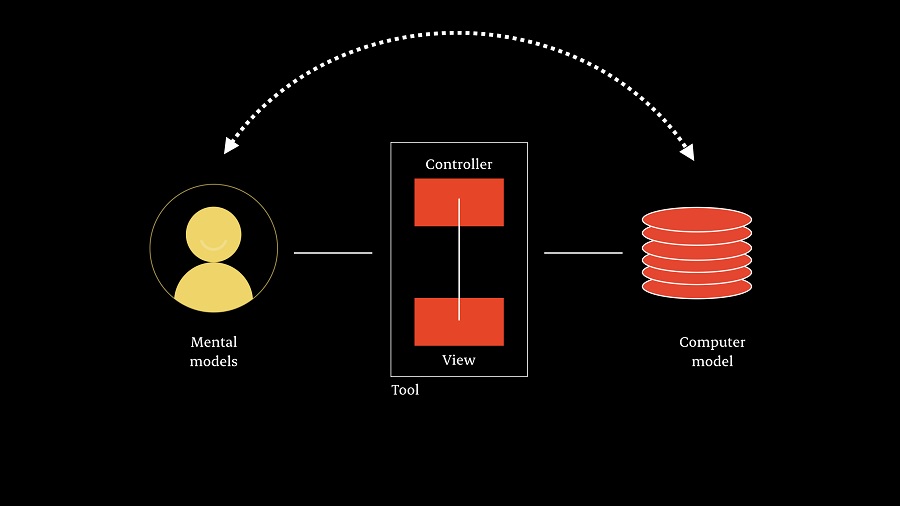
The next step was the creation of systems. In the late 70's Alan Kay was working on human–first tools at Xerox Parc. He was keen on releasing systems that are user-friendly and intuitive to use. The problem was that at the time there was no server architecture that could connect data to users in an intuitive way. To that end Kay brought in Trygve Reenskaug, who together with Adele Goldberg, came up with the first version of Model View Controller.

Reconstruction of the original version of Model View Controller
A simple, and highly flexible mean of connecting large quantities of data with users, in an intuitive way. The core principle was powerfully simple–map human mental models to computational behavior. That core idea single-handedly set the foundation for the field user interface (UI) and the technological framework for graphic user interfaces (GUI).

As time progressed–and especially once the internet opened up–MVC became flatter and more industrialized. In its original version MVC is a triangular relationship between a human, a machine and a tool. Keeping the tool (and any monetization of it) away from users, or data. In the new industrialist version it made more sense to guard the data, especially for its monetization potential, and offering the utility more as a mean to contain users within the boundaries of your system (more on this idea in Gated Products).

Modern, flatter version of Model View Controller
Through the joint work of Shannon and Reenskaug we have written a status quo of extreme abstraction and rigid efficiency. The meaning of information is irrelevant, all data can be reduced to 1’s and 0’s. Once reduction has taken place we can store our data in stationary databases, serve it through a proprietary interface point, anchor user behavior through a set of utilities and guard the system from any type of interoperability.

In Information and the Modern Corporation (MIT Press) by James W Cortada makes the crucial distinction that industrialist thinking taught us to forget.

First, we have data, then we can hopefully deduce some information from it, and only later it becomes knowledge.

Data, information, knowledge, and wisdom all are needed by people to do their work and live their lives.

Data are facts, such as names or number. If sensors are collecting these, there are electronic impulses when something happens when something moves.

Information is slightly different in that it combines various data to say something that the data alone can’t say. For instance, data on our spending habits tell us about our financial behavior and about our patterns of expenditures–that is information, not just groups of unrelated numbers.

Knowledge is more complicated than data or information because it combines data, information and experiences from logically connected groups of facts (such as budget data from a department) with things that have no direction or obvious connection (such as previous jobs and experiences).

It follows that: data ≠ information ≠ knowledge ≠ wisdom

Back to Shannon’s reductionist approach and Reenskaug’s assembly line. Are we moving data, information, knowledge or wisdom? Traditionally (in the last 70 years) we used to decode human knowledge into organized information models and then scatter it as data across communication channels only to later have that encoded back into tabular information and cognitively processed into knowledge.

As our machines are starting to be able to semantically understand information (speaking to Alexa is one example), new questions will need to be answered. How much decoding do we need to do when using a system? Do we really need to go to a terminal (phone, or laptop) and fit things in boxes for the machine to work? Is there a way for the machine to come closer to the way we exchange knowledge and wisdom? and What can be done to ease the encoding on the human recipient side? What form should information be in when we receive it back from a machine?

The question of communication between humans and machine is complex and multilayered. It bridges linguistics, computer science, cognition and design. This is the question this research tries to address.

Some thoughts about language in conversational systems. Part of an ARB Major Seed Grant, from McMaster University (Canada), titled Language Architecture as a Model of Human-centered Artificial Intelligences (PI: Ivona Kučerová, Collaborators: Nitzan Hermon & Ida Toivonen).

Nitzan Hermon is a designer and researcher of AI, human-machine augmentation and language. Through his writing, academic and industry work he is writing a new, sober narrative in the collaboration between humans and machines.


Originally published on EVERYTHING WILL HAPPEN and THE CREATIVITY POST