Monday, January 16, 2017

JANUARY TO INSPIRE: Dr Bennet Ifeakandu Omalu, A Fine Nigerian Mind

Dr Bennet Omalu
Bennet Omalu discovered Chronic Traumatic Encephalopathy in former football players, sparking years of denial from the US NFL and the creation of a movie about his life's work.

“There are times I wish I never looked at Mike Webster’s brain. It has dragged me into worldly affairs I do not want to be associated with. Human meanness, wickedness and selfishness. People trying to cover up, to control how information is released. I started this not knowing I was walking into a minefield. That is my only regret.”
—Bennet Omalu

Synopsis
Born in Nigeria in 1968, Bennet Omalu graduated from the University of Nigeria's medical school, before continuing his training in the United States. In 2002, he discovered the presence of a degenerative disease in the brain of former pro football player Mike Webster, naming the condition chronic traumatic encephalopathy (CTE). His efforts to raise awareness of CTE were rebuffed by the United States' National Football League (NFL), although mounting evidence eventually forced the league to make concessions. Omalu's work was dramatized in the 2015 film Concussion, with Will Smith portraying the Nigerian-born doctor.

Early Years and Career
Bennet Ifeakandu Omalu was born in Nnokwa, Nigeria, in September 1968, during the Nigerian Civil War. The conflict had forced his family to vacate its gated compound in the village of Enugwu-Ukwu, but they were eventually able to return there to resume a comfortable lifestyle. 

The sixth of seven children of a civil engineer and a seamstress, Omalu was a shy but gifted student with a fertile imagination. He was admitted to the Federal Government College in Enugu at age 12 and dreamed of being an airline pilot. However, at age 15 he began medical school at the University of Nigeria. 

After earning his degree in 1990, Omalu interned at Jos University Hospital, before being accepted to a visiting scholar program at the University of Washington in 1994. He then served his residency at Harlem Hospital Center, where he developed his interest in pathology. 

In 1999, Omalu moved to Pittsburgh to train under noted pathologist Cyril Wecht at the Allegheny County Coroner's Office. He continued his education at the University of Pittsburgh, completing a fellowship in neuropathology in 2002 and a master's in public health and epidemiology in 2004. 


Dr Bennet Omalu's Profile in September 2009 issue of GQ
Discovery of CTE 
While working at the coroner's office in September 2002, Omalu examined the body of Mike Webster, a former pro football player with the NFL's Pittsburgh Steelers. Webster had displayed patterns of distressing behavior before his death from a heart attack at age 50, and Omalu was curious as to what clues the former player's brain would reveal. 

After careful examination of the brain, Omalu discovered clumps of tau proteins, which impair function upon accumulation. It was similar to "dementia pugilista," a degenerative disease documented decades earlier in boxers, though it had yet to be connected to football players. After confirming his findings with top faculty members at the University of Pittsburgh, Omalu named the condition chronic traumatic encephalopathy (CTE) and submitted a paper titled "Chronic Traumatic Encephalopathy in a National Football League Player" to the medical journal Neurosurgery. 

NFL Denial 
After the paper was published in July 2005, Omalu was informed by Neurosurgery's editorial board that the NFL's Mild Traumatic Brain Injury (MTBI) Committee was demanding a retraction. Omalu instead pressed forward with his examination of Terry Long, another former football player who had committed suicide at age 45, and discovered the same buildup of tau proteins. His follow-up paper to Neurosurgery was published in November 2006. 

As the mouthpiece of the NFL, the MTBI Committee discredited Omalu's research as "flawed" and refused to acknowledge a link between the sport and the brain damage in former players. However, Omalu gained an important supporter in Dr. Julian Bailes, chairman of neurosurgery at the West Virginia University School of Medicine and a former team physician for the Steelers. With Bailes and lawyer Bob Fitzsimmons, Omalu founded the Sports Legacy Institute (later renamed the Concussion Legacy Foundation) to continue studies of CTE. 

Despite the NFL's public evasiveness, Omalu and his supporters scored a victory when Mike Webster's family was awarded a significant settlement in December 2006. The following June, NFL Commissioner Roger Goodell convened a "concussion summit" to discuss the issue with league doctors and independent researchers, although Omalu was not invited to participate. 

Continued Studies and 'Concussion' 
Omalu moved to California in the fall of 2007 to begin his new position as chief medical examiner of San Joaquin County, though he continued his post-graduate education at Pittsburgh's Carnegie Mellon University and earned his MBA in 2008. That year, he also published his first book, Play Hard, Die Young: Football Dementia, Depression, and Death, and he advanced the study of CTE by branching out to athletes from other sports and war veterans. 

By 2009, Omalu's exhaustive work on the subject began to bear fruit. He was profiled in a September issue of GQ, which detailed his efforts to raise awareness of football-related brain injuries and the NFL's refusal to cooperate. Commissioner Goodell and other NFL executives were soon called to testify before a House Judiciary Committee, sparking an overhaul of the MTBI and rule changes to enhance safety, as well as a lawsuit brought forth by thousands of former players against the NFL. 
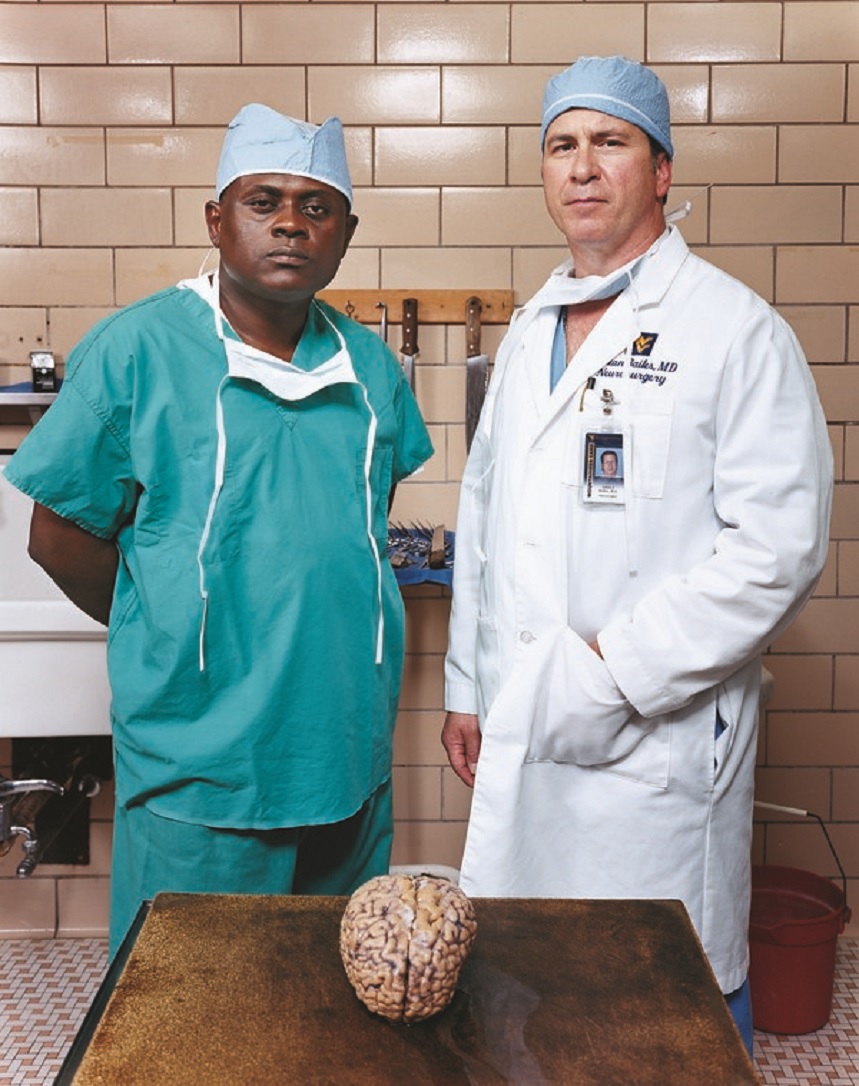

From left, Bennet Omalu, the pathologist; and Julian Bailes, the neurosurgeon. (Photo: Mike Heithoff)
Omalu's story eventually reached the hands of Hollywood power player Ridley Scott, who tapped Peter Landesman to write and direct a feature film, and convinced actor Will Smith to sign up for a starring role. Titled Concussion, the film generated major buzz before its Christmas Day 2015 release. 

For Omalu, the release of Concussion served as the ultimate vindication for years of hard work, and provided a spotlight for other endeavors. Along with his position as chief medical examiner for San Joaquin County, he serves as president of Bennet Omalu Pathology, as well as associate clinical professor of pathology at UC Davis Medical Centre.

Source: Biography.com

Wednesday, January 04, 2017

The Most Important Lesson For Effective Personal Growth I have Learned Blogging: GET YOUR "DELETE" BUTTON READY

Image credit: NAIJAGRAPHITTI IMAGE BANK
By Kenneth Nwachinemelu David-Okafor

Happy New Year EVERYBODY!

I thought what would be a special New Year Gift I would share with NAIJAGRAPHITTI BLOG readers and future readers for 2017.

What can be so SPECIAL and UNIQUE for a crop of people who have given me every reason to be a better writer, better thinker and invariably a better person, for Thinking and writing actually presses you to achieve higher degrees of fidelity. I suddenly realized it was ripe time to share the second lesson for effective living and greater productivity I have learned blogging.

But nonetheless every insight that I shared can apply to several spheres.

PLEASE, do not be afraid to be different in 2017; IF YOU ARE NOT DIFFERENT YOU WOULD HARDLY BECOME DISTINGUISHED. Not by a long shot.

But more importantly I would like to share with you that for you to gain speed and precision this year you should travel light. No excess baggage!

How do I mean?

Anything you do not need to move from Point A to Point Z in your life, DISCARD! Point Z being the purpose of God for your life! See that button marked "DELETE" on the keyboard of life: USE IT.

Check everything that would dampen your motivation and feel completely free and uninhibited to click "DELETE".

I will share just a few of the most important features to delete.

The first set for immediate "DELETE" action: everything that would make you postpone taking action as a result of insights you gain from this post. 

That would be the spirit of procrastination.

The best plans and resolutions in the world are destroyed because of procrastination. Beware that procrastination’s first child is indecision.

Prepare to become a more decisive person in 2017. Go ahead and take prompt steps. If you want perfect conditions then wait for eternity perhaps one very smart person would develop an apps for taking quick action.

The second set for immediate "DELETE" action: every idiosyncrasy which dampens your passion.

2017 is a year that you must muster great PASSION to achieve excellent results. When results are built on passionate commitment you are closer to achieving being a success and superb brand status.

The profit motive is no longer just money but creating value.


Image credit: Zulama Modern Learning
The third set for immediate "DELETE" action: whatever stops you from training for new skills and building your capacity.

Get skills. Skills and personal competence would stand you out. This is a message for every season.

Skills are simply the things you learn that enable you to perform certain tasks. There are several types of foundational skills including Basic Skills, Thinking Skills, People Skills in addition to Personal Qualities

By knowing the "language" of skills, you can communicate them to others by understanding, describing, and discussing them.

Your success requires continuous improvement – strengthening and learning new skills. Start directing your own skills education – I excited you are making the first step by reading this article!

The fourth set for immediate "DELETE" action: anything that makes you contribute to the culture of mediocrity degrading and destroying Nigeria.

Nigerian and this foul attitude emasculating merit, excelling, and distinctioning (I coined this phrase after deep reflection) in 2017 must become discarded from your environment, psychologically and physically.

Distinctioning, in my view, is aiming and striving for distinction in all that you think, do and expect in your life, on a continual and consistent basis.

Aim to deliver superb results for 2017. It your fundamental social entitlement. Give your best and expect the best from everybody else. Do not shortchange anybody with mediocre performance.

The fifth set for immediate "DELETE" action: people who claim to be your friends/acquaintances/counsellors but they have not prioritized their relationship with you.

How do you confirm the identity of this set of actors?

Simple. Check all those people who consider your presence worthwhile only when you are discussing and bothering with them about issues pertaining to their own lives. The same people may pretend they are praying for you and all what not, but you have little value beyond your utility to meet their own needs.

If your think you are a person of faith and thus fared better then you are deceived. There are many people who cannot define and demonstrate friendship by their lives and conduct.

For 2017 to be a VIBRANT and CREATIVE year, you need people who can affirm your potential. They do not need to be praise singers or anything of the sort. But they must be solid and dependable, competent with right thinking and able to walk you through a maze of confusion. They should be straightforward people who are not afraid to tell you that they do not know what you are talking about.

For the writer, they must be people who read works that you give them to read and give you weighted feedback. Do have such people around you? If yes, get more and if no, work on this at once.

The final set for immediate "DELETE" action: impatience.

Give yourself time to achieve stellar results. How much time is at your complete discretion. You may determine the length of time you need as you get into self-awareness and self-mastery.

Life is not akin to magic; you should understand process. Even if you are ambitious and overachieving, you need time to mature your accomplishments. You can change the world but you hardly do so in an instant.

Go ahead and give yourself the best opportunity to make 2017 the best year of your life yet.

Five African Inventions To Look Out For In 2017

Here are five African inventions which may take off in 2017.

An Electricity Grid for the Whole Village
GETTY IMAGES
Problem: A total of 1.3 billion people worldwide currently don't have electricity, according to Yale Environment 360. Getting people in rural areas on to the national grid is proving too difficult and traditional solar panels generate meagre amounts of energy.

Solution: Steamaco makes solar and battery micro-grids which can work for a whole village. They are small electricity generation and distribution systems that operate independently of larger grids.

How it worksMicro-grids are nothing new. The new part is that Steamaco's technology automates the regulation of electricity.

So, if the system detects there will be a surge in demand for electricity, for example on a Saturday night when people want to start playing music for a party, or they see a dip in supply, like when the sun has gone down and so the grid is not collecting solar energy, then the grid automatically stops electricity for people it won't affect too badly.

The system sends an automatic text to all customers on the grid saying that the electricity in houses is about to be cut off so that the hospital can keep on going.

Who is talking about this? In June the Kenyan company won awards from the clean energy charity Ashden, reports the Guardian.

Grey line
A Jacket That Detects Pneumonia
BRETT ELOFF
Problem: Pneumonia kills 27,000 Ugandan children under the age of five every year. Most of these cases are due to pneumonia being misdiagnosed as malaria.

Solution: Ugandan engineer Brian Turyabagye has designed a biomedical "smart jacket" to quickly and accurately diagnose pneumonia. The Mamaope jacket measures a sick child's temperature and breathing rate. It can diagnose pneumonia three to four times faster than a doctor and eliminates most possibility for human error.

How it worksA modified stethoscope is put in a vest. It is linked to a mobile phone app that records the audio of the patient's chest. Analysis of that audio can detect lung crackles and can lead to preliminary diagnoses.

Who is talking about this?: It is shortlisted for the 2017 Royal Academy of Engineering Africa Prize.

Grey line
A Tablet That Monitors Your Heart
ProblemIt is difficult for people in rural areas to travel to the cities to see heart specialists. There are just 50 cardiologists in Cameroon, which has a population of 20 million people.

SolutionArthur Zang invented the Cardio Pad - a handheld medical computer tablet which healthcare workers in rural areas use to send the results of cardiac tests to specialists via a mobile phone connection.

How it worksCardiopads are distributed to hospitals and clinics in Cameroon free of charge, and patients pay US$29 (£20) yearly subscriptions. It takes a digitised reading of the patient's heart function. In a few seconds the results of a heart test are sent to a specialist clinic in the capital.

Who is talking about this?It won the Royal Society award for African engineering in 2016 and the Rolex award for Enterprise in 2014. But Mr Zang told BBC Africa that these things take time to develop and it only got approval from the Cameroon authorities in October 2016.

So, it is more likely that people will actually see it in their clinics in 2017.

Grey line
An App for Hair Inspiration
TRESS
ProblemA lack of accurate information about how to achieve certain hairstyles and where to find a high-quality stylist.

SolutionThree software engineers - Priscilla Hazel, Esther Olatunde and Cassandra Sarfo - invented Tress, an app to share ideas about hairstyles.

How it worksIt is described by Okay Africa as a kind of Pinterest or Instagram for hair. Once you have downloaded the app, you can follow other people who are sharing their hairstyle. You can search specifically by place, price range and the type of hairstyle your want, from relaxed hair to cornrow.

You can then scroll until your heart's content through people who have uploaded pictures of themselves with that style, tell them how much you like their style, ask how long it took, and even arrange to meet up with someone to style your hair.

TRESS
Who is talking about this?The three software engineers behind this are graduates of the Meltwater Entrepreneurial School of Technology in Accra, Ghana.

They were then selected for the Y Combinator eight-week fellowship programme for start-up companies.

Y Combinator is prestigious - business news website Fast Company called it "the world's most powerful start-up incubator". In other words, the school is thought of as really good at finding the next Mark Zuckerberg.

Grey line
A Currency for Paying Online Workers
GETTY IMAGES
Problem: There are online workers, specifically web developers, in Africa who people outside the continent would like to employ but it is difficult or prohibitively expensive to get their wages to them. Some don't have passports, and so don't have bank accounts either.

Solution: Bitpesa uses Bitcoin to significantly lower the time and cost of remittances and business payments to and from sub-Saharan Africa.

How it works: Bitpesa uses the crypto-currency bitcoin as a medium to transfer cash across borders. Bitcoin is a system of digitally created and traded tokens and people keep their tokens in online wallets.

It then takes the Bitcoin tokens and exchanges them into money in mobile money wallets - a popular way of paying for things in places like Kenya and Tanzania.

BitPesa is already used to pay online workers - a company called Tunga is using it as a way of getting wages from clients abroad to web developers in Uganda.

Who is talking about it?: It won an award for the best apps across Africa in November.

Grey line
Originally published on BBC