Thursday, February 09, 2017

NEWS POST: How Six Young Women Invented A Life-Changing Device In Less Than A Day

Image: Courtesy of Team Tactile
With just a few hours left to build a groundbreaking gadget, things weren't going as smoothly as planned.

Six young women, all undergrad engineering students at Massachusetts Institute of Technology, MIT, had established a lofty goal: to create the first-ever affordable device that immediately translates printed text into Braille. The idea could prove revolutionary for the blind community, transforming how they read while also creating sorely needed opportunities for children with low or no vision.

But throughout the hectic, 15-hour MakeMIT hackathon last February, the women — competing as Team 100% Enthusiasm — were running into snags. The lines for hackathon participants to use the 3D printers were taking forever. The team laser-cut the wrong material for the casing. And the optical recognition software they wanted to use — crucial for the device to actually work — wasn't turning up accurate translations of text. 

"It turned out to be a lot harder than we thought," says Charlene Xia, one of the team members.

With only 15 minutes left on the clock, they finally had a working prototype — albeit a crude one. The device was big and hastily taped together in places, with wires poking out and only a few pins for Braille characters.

"It was janky," Xia says, laughing. "But it worked."

An early Tactile prototype. Image: Courtesy of Team Tactile
It did indeed work, enough so to take first place in the hackathon. The device, dubbed Tactile, had been born. 

A year later, Team 100% Enthusiasm has been renamed Team Tactile. The women are already making waves with their invention, both in terms of accessibility and advancing the visibility of women in tech.

But with a ways to go before Tactile hits the market, and big plans for the future, they're really just getting started.

A collective goal to (affordably) change the world
Image: Courtesy of Team Tactile
Right before the hackathon, the young women were sitting in Xia's bedroom, deciding what to build. Their ideas ranged from a dancing robot so people wouldn't be lonely at clubs to an alarm clock that would wake you up by splashing water in your face.

They quickly realized, however, that they really wanted to create something that could change the world for the better.

One teammate brought up a concept design she'd seen of a Braille watch. They toyed with the idea of building a text-to-Braille converter, but figured something like that had to already exist. So they did what any of us would do — they Googled it.

"There were a few things, like refreshable Braille technology, that cost like US$3,000. And we were like, 'Holy crap. Why is this so expensive?'" Xia says.

Images of the MakeMIT hackathon prototype. Image: Courtesy of Team Tactile
According to the American Foundation for the Blind, refreshable Braille displays, which typically help blind users read information from a computer screen, cost between US$3,500 and US$15,000 depending on the number of characters they have. Portable devices on the market, like the Android-based B2G, still cost around US$2,500. The technology is expensive, and just two companies essentially have a duopoly on the tech. The devices are typically sold by the Braille dot (one character has six dots), and they can go for US$30 or more per dot.

But Tactile, proposed to be the size of a candy bar with 36 characters (216 dots), could cost as little as US$100.

A rendering of the future Tactile prototype. Image: Courtesy of Team Tactile
Here's how it works: You slide the device over printed text, like a book, menu, or even a packaging label. The camera captures images of the words and sends them to a microcontroller, which then performs text recognition. That information, via an electromagnetic activation mechanism, moves the pins up and down at the top of the device, translating the text into Braille. Like with other displays, the Braille characters physically refresh as they scroll through sections of text.

"We're using cheaper material and an easier manufacturing method," says Xia, and this drives down prices.

US$100 is just an estimate. But even if they land at US$200, Team Tactile still thinks it will be a success.
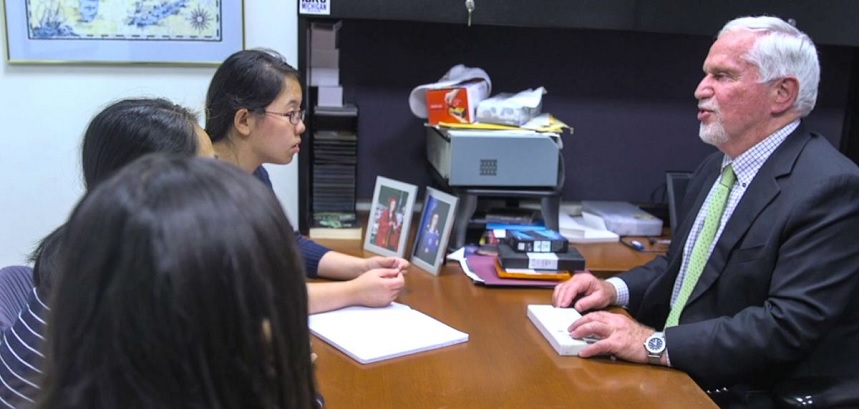
Paul Parravano, co-director of MIT's Government and Community Relations office, gives Team Tactile feedback from a blind person's perspective. Image: Courtesy of Team Tactile
The tech effect on Braille
Approximately 1.3 million Americans are legally blind, though millions more live with a visual disability. At the end of 2015, an estimated 61,739 students were reported as legally blind. Globally, 39 million people are blind and 246 million have low vision.

But if you think about how much the iPhone has evolved over just the past decade, the stagnant Braille display market looks archaic in comparison.

Since the blind community is a relatively small percentage of the overall population, there's a perceived lack of demand for improved Braille technology. There's not a huge incentive for companies to develop better tech for the blind.

As a result, Braille displays are more or less the same as they were 30 years ago.

Charlene Xia, of Team Tactile, works on the technology behind the device. Image: Courtesy of Team Tactile
In the advent of new technologies like VoiceOver and other text-to-speech software, Braille literacy rates are declining. Only an estimated 10 percent of children learn Braille today, because it's often seen as too difficult, time-consuming or outdated to teach. But advocates argue Braille is just as important as ever, especially when it comes to employment.

Up to 70 percent of blind people are unemployed, according to widely cited statistics, due to discrimination, misconceptions, distance barriers and other factors. But 80% of blind people who are employed have something in common: They can all read Braille. It helps them learn things like grammar and punctuation, and how to read charts and graphs — all difficult, if not impossible, to learn using text-to-speech.

"One of the biggest things we learned is that most visually impaired families fall below the average income class," Xia says. "They don't have the proper education ... because they can't afford the tools to get the information they need to get higher-income jobs."

It's a vicious cycle, Xia says, and one Team Tactile hopes to break. 

"We really hope this technology will offset the market and just open up some competition, and drive the price down as much as we can," she says.

Unexpected role models
Regardless of how it was conceived and produced, Tactile is an invention that can open doors for the blind community.

Nevertheless, it's noteworthy that it was six young women in their early 20s who created such a life-changing device. The number of women in science, technology, engineering and math (STEM) fields is still lackluster, thanks to stereotypes, bias and an often unwelcoming climate at universities.

Team Tactile (L-R): Chandani Doshi, Jialin Shi, Bonnie Wang, Charlene Xia, Tania Yu and Grace Li. Image: Courtesy of Team Tactile
To wit: In 2013, only 18% of people who graduated with a computer science degree in the U.S. were women. Professionally, women make up only 29% of the science and engineering workforce. A recent study found that gender stereotypes around STEM can affect girls as young as age six.

But gender doesn't change anything for Team Tactile. "Our team isn't really thinking, 'Oh, we're women,' working differently in any way," says team member Tania Yu. "This is what we enjoy, this is what we want to do, so we just went for it."

And that's Team Tactile's message for young girls: If you're interested in science and engineering, don't be afraid to go for it.

"They can see us and be like, 'They can do it; we can do it, too.' And they don't have to feel like it's only men doing this," Yu says.

Xia sees a lot of Facebook posts and videos of new inventions, and the inventors always seem to be men. She admits it can be subconscious for younger girls. If you only see men doing it, you might start to believe women can't.

"We're happy that when we have a Facebook post up about our project, maybe girls are watching it ... and maybe they'll consider applying to STEM fields and try it out," Xia says.

The future is Tactile
After last February's hackathon, Team Tactile was accepted into Microsoft's #MakeWhatsNext patent programme, which provides legal help to women inventors throughout the complex process of getting a patent. They applied last September, and Tactile received "patent pending" status that same week.

In the meantime, they're working on different iterations of the prototype, aiming to meet the accepted standards for refreshable Braille displays in terms of size and durability.

The current Tactile prototype. Image: Courtesy of Team Tactile 
The last step is creating an accompanying app, so people can connect Tactile to their smartphones and use the device beyond printed text.

"We plan for this semester — our last semester — to be a sprint toward our goal," Xia says. "A couple of people on our team have already decided to work on this after graduation. But, ideally, by the end of this semester — June of this year — we will have our first ideal prototype."

And Team Tactile won't stop there. The long-term goal is to see this brought to production. Ultimately, they want any blind or low-vision child to be able to use to the device for all purposes, from school to everyday life.

"We want this to open up information access to the entire visually impaired community," Yu says. "We can really help remove some of the various barriers they face."

Originally published on Mashable

Thursday, February 02, 2017

NEWS POST: Four Inventors, Whose Work Spans Over Three Decades, Win The Queen Elizabeth Prize For Engineering

This 1972 edition of Electronics magazine shows the blurred first image 
The Queen Elizabeth Prize is a global £1million (US$1.2million) prize that celebrates a ground-breaking innovation in engineering.

It has run since 2013, when the first prize was awarded to the creators of the Internet, the browser and the World Wide Web. 

The prize rewards an individual or team of engineers whose work has had a major impact on humanity.

The prize also celebrates engineering as a discipline and career choice in an attempt to get more young people involved in the subject.

Dr Michael Tompsett, pictured with wife Margaret, was one of four winners of the Queen Elizabeth Prize for Engineering, netting the award for inventing the digital camera. He is shown here with his original camera
As the inventor of the digital camera, you’d think that Dr Michael Tompsett would be a
rather enthusiastic snapper.

But the man whose ideas led to Instagram and the cameraphone actually bemoans the very ‘selfie culture’ that he helped to create.

And the 77-year-old Briton, who was yesterday awarded the Queen Elizabeth Prize for Engineering along with three others, has even admitted that at times he regrets inventing the device.

Speaking as he accepted the £1million award, the highest accolade for engineering, the pioneer admitted that he is irritated by people using digital cameras to take selfies.

He said: ‘I never take selfies. It’s totally unnecessary.

‘Here in London, for example, there are hordes of tourists even at this time of year and outside Westminster Abbey and the Houses of Parliament you can’t go anywhere without people standing in the middle of the pavement taking pictures and taking selfies, and shoving selfie sticks in front of you.

‘At that point I just say, “Why the hell did anybody invent this stuff?”

‘How many people look at their selfies? It’s just to prove they are at a particular location.

‘I don’t think you are doing justice either to yourself or to the location, frankly.’ 

Dr Tompsett, who was originally from Writtle, Essex, and now lives in Cape Cod, Massachusetts, added: ‘Of course, it’s generational. I’m in the older generation and younger folks are doing this all the time.’

And despite his invention making it possible to take large numbers of pictures, he prefers to stick to just taking one or two.

The Cambridge graduate added: ‘Film was expensive, and I used to develop and print the pictures myself as well and it took a lot of time. 

'I would compose pictures in various ways very carefully.

‘I still tend to do that. Even though I could take ten, 20, 100 on my phone now, I tend just to take one.’

However, despite his apparent hatred of selfies, Dr Tompsett seemed happy to make an exception yesterday – taking a snap with two of his fellow prize winners: Nobukazu Teranishi, of Japan, and Eric Fossum from the US.

The CMOS device, also known as 'camera on a chip' technology, now features in most modern digital cameras
In the 1970s and 80s, they, along with fourth prize recipient American George Smith, developed a series of electronic sensors that transformed digital imaging and made most film-based photography redundant.

It began in 1971, when Dr Tompsett, who was working at Bell Laboratories in the US, realized a device invented by colleagues for computer memory circuits could have another use: taking pictures.

Called a ‘charge-coupled device’, it converts light to an electrical signal.

And in 1972, his wife Margaret appeared in the first colour digital image – on the cover of the magazine International Electronics. 

Professor Teranishi invented a device called the pinned photodiode, or PPD, which allows higher resolution digital images.

And Professor Fossum came up with the complementary metal oxide semiconductor, or CMOS, which led to ‘a camera on a chip’.

The £1million (US$1.2million) Queen Elizabeth Prize this year went to the developers of technologies that convert light into digital signals. Princess Anne is pictured giving the prize to (left to right) Dr Michael Tompsett, Professor Nobukazu Teranishi, and Professor Eric Fossum
However, while a Briton had a key role in inventing the digital camera, the biggest beneficiaries may have been in Asia, where most of the devices are manufactured.

But it wouldn’t be the first time that a British invention was exploited worldwide.

Other UK electronic creations include the television, made in 1925 by John Logie Baird, and the first video recorder, called the Telcan, which was invented in 1963 by Norman Rutherford and Michael Turner of the Nottingham Electronic Valve Company.

Originally published on Daily Mail UK

Monday, January 30, 2017

Developing Inventive Creativity And Inventive Activity In Nigeria

NAIJAGRAPHITTI IMAGES BANK
By Kenneth Nwachinemelu David-Okafor

Kenneth Nwachinemelu David-Okafor
How many inventors are there in Nigeria?

Whatever you have guessed as the answer, know this: as long as your name is not in that number then I have a message for you: you can make yourself relevant in 2017 by becoming an inventor or encouraging someone you know to become one!

Think of the possibilities, what you could accomplish, what you could contribute or what the person you motivate could accomplish, could contribute to the growth and reputation of Nigeria.

The good news is that becoming an inventor is not impossible if you are prepared to put in the required diligence.

How?

Let me share this with you: who is an inventor?

Inventor  a person who brings ideas or objects together in a novel way to create an invention, something that did not exist before. 

The Encyclopaedia Britannica (2017) notes, “Inventors defy definition; as a result, they are frequently defined by what they are not. For example, though there is a close relation between invention and science and engineering, an inventor is not necessarily a scientist or an engineer. A scientist is said to be a discoverer—that is, somebody who by acute observation and brilliant analysis is able to find and explain something that already exists in nature. An engineer, meanwhile, uses existing technology and scientific understanding to design better objects or processes. But an inventor, it is said, creates something that had never previously existed.”

The University of Tennessee Research Foundation makes a very important distinction between who is an inventor and who is not an inventor. On the UT Research Foundation website, the author(s) writes, “Who is an inventor? - Basically, the inventors are all the people who contributed to the conception of the invention. Conception is the mental part of invention – formulating a mental representation of the means to achieve a desired result. While there may be considerable work involved in building and testing this mental representation to create a tangible invention (which is referred to as the “reduction to practice” in patent law), only individuals who contributed to the conception of the idea are inventors on the patent.

“Who is not an inventor? - An individual who was involved in the reduction to practice of an invention, but not the conception, is not an inventor. A department head or dean who did not have any direct role in the making of the invention is not an inventor. The sponsors who provided the funds supporting your work on the invention are not inventors. A colleague who generously provided materials for you to build or test your invention is not an inventor.”

So you can right from the bat that is someone who contributes to the conception of the invention. You therefore can get a feasible idea and get other professionals to build it! You do not need to be a scientist or an engineer to become an inventor!

If you are lacking ideas of areas in which you can develop an invention then I can share with you some key areas in which Nigeria has great needs.

There are ideas I have shared in an e-book (cover picture above) COMING OUT SOON: 

INVENTORS, INVENTIONS & INVENTIVE THINKING SHORTAGES
Key Reasons Why Nigeria Is Short Of Inventors
Cultural, Scientific, Educational, Environmental, Political and Other Factors Constraining Nigeria's Inventiveness and Inventive Endeavour

When I decided that it was not worth complaining about Nigeria when I get frustrated that nothing seems to change I decided that I would do something: I aspire to contribute to transform Nigeria from a rabidly consumerist country to a more productive and inventive country!

Please get this right, many people assume Nigeria is a creative country; and it is to the degree that it has a well-documented and vibrant creative industry sector BUT CREATIVITY IS SO MUCH MORE THAN MUSIC, NOLLYWOOD AND ENTERTAINMENT. More importantly, we, Nigerians, are not, I dare say, as imaginative as we pride ourselves. Through action research, I discovered that Nigeria’s education system and its operators have not prioritized the development of creativity across several disciplines (including inventive creativity), critical thinking and creative problem solving.

Let me present some hard facts before you:

o  Nigeria was awarded less than 10 U.S. patents per one million residents between 1985 and 2014. But just for 2014, China got 801,135; United States got 285,096; Russian Federation got 24,072; United Kingdom got 15,196; Israel got 1,125; Singapore got 1,303; South Africa got 802 (See World Intellectual Property Organization, WIPO, WIPO Patent Report: Statistics on Worldwide Patent Activity.)

o   Nigeria has about 143 universities (federal, state and private) and none of them has prioritized the teaching and fostering of creativity and innovation. (NB: only one the Rivers State University of Science & Technology has the word “creativity” in its moto: “excellence & creativity”).

o       Nigeria has about 200 tertiary institutions (federal, state and private) and all of them combined have not tallied up to 100 high priority patents within the last 10 years.

o  According to a new market research report, 'World Mobile phone & Smartphone Market (2010 – 2015)', published by MarketsandMarkets, the total global mobile handset market was expected to reach US$341.4 billion by 2015 while smartphone sales will account for 75.8% of the overall mobile handset revenue at US$258.9 billion.

Of this total sales, about 120 million handsets would be sold in Nigeria within less than the same period. Not one Nigerian, DEAD OR ALIVE, would get a single dollar as royalties for any part or parts of a Smartphone invention or patent.

o       Nigeria has produced only one Nobel Prize winner (and that is in Literature).

o      Nigeria suffers chronic electric power shortages but the authorities have spent almost US$20 billion dollars in the last 20 years tackling the same problem and it has not been sorted.

o   The Federal Ministry of Education and most Nigerian universities in 2016/2017 budgeted more money (90% and above) to recurrent expenditure and less than 10% to capital projects. In lay language, this means that the ministry and universities would pay salaries rather than purchase tools/equipment/build infrastructure for the use of those who would earn the same salaries they have budgeted for would use to do the job for which the salaries would be earned!

I am tired of complaining!

I want to do something; so I am going to motivate you and I.

I have a simple message for you: do something to make your life positively affect someone else’s with your idea or product (indeed invention) in 2017.

If you lack any originally ideas of your own then read:

INVENTORS, INVENTIONS & INVENTIVE THINKING SHORTAGES
Key Reasons Why Nigeria Is Short Of Inventors
Cultural, Scientific, Educational, Environmental, Political and Other Factors Constraining Nigeria's Inventiveness and Inventive Endeavour 

To answer the opening question, Nigeria has than 100 inventors (in-country and abroad). This is abysmally low for a country with an estimated population of 180 million.

Like I said I am tired of complaining.